

Home › Services › Business Valuation › Startup & Company Valuation
Startup & Company Valuation in Ahmedabad and Across India
A reasoned, documented value of your business, built on your financials and explained so that investors, lenders and your own board can follow every step. Led by CFA Level III and Level I cleared finance professionals, with a written scope before work begins.
- A defensible value with the method explained
- Workings in Excel that you can check and update
- A walkthrough so you can answer investor questions
Written scope first · Confidential · Free first consultation
What it is and when you need it
A valuation estimates what your business, or a share of it, is worth on a given date. People usually ask for one when something is about to change: a founder is issuing shares to an investor, a partner is selling out, a company is converting or merging, a lender wants comfort on a pledged asset, or the owners simply want to know what they have built.
There is no single right number. The value depends on the purpose, the method used and the assumptions behind it. A startup with little revenue is usually valued on its projected cash flows or on comparable deals. A stable trading or manufacturing business is usually valued on its earnings, assets and cash flow. We choose a method that fits your purpose, explain why, and show how the number moves when an assumption changes.
Good valuation work is mostly about the quality of the inputs. We read your financial statements, test whether your projections tie back to them, and ask hard questions before the report is written rather than after an investor asks them.
Why a startup needs a valuation
Founders usually need a valuation for one of four reasons: to price a funding round, to issue shares to an investor or employee, to settle an exit or buy-out between partners, or to meet a legal requirement. A valuation is an opinion of value on a stated date and for a stated purpose, and the purpose changes the method and the report you need.
Methods we use, and when
For companies with a forecast, the discounted cash flow (DCF) method discounts projected cash flows to a present value. For companies with comparable listed or transacted businesses, multiples such as revenue or EBITDA are used. For very early companies with little revenue, scorecard-style and venture methods are used alongside, and we say plainly how much weight each method gets.
The value you want and the value that can be defended are not always the same. We show the range, the assumptions behind it and a sensitivity table, so you know how far the answer moves if growth or the discount rate changes.
When the law needs a registered valuer
Some valuations must be signed by a Registered Valuer or a SEBI-registered merchant banker, for example certain share issues under company law, FEMA rules for non-resident investment and income-tax rules for unquoted shares. Our guide on valuing unquoted shares explains how those rules interact. We prepare the analysis and coordinate signing through licensed partners where the law requires it.
Who it is for
Startups raising a round
Founders who need a defensible pre-money value before talking to angels or funds.
Share transfer or exit
Owners or partners agreeing a price for a sale, buy-out or retirement.
Allotment of shares
Companies issuing shares who must support the price they have chosen.
Lender or board needs a number
Businesses that need an independent view of value for a bank or their directors.
What you receive
- Valuation report (PDF) with the purpose, method, assumptions and conclusion
- Excel model with working formulas, so you can change assumptions
- Summary of the key drivers and what would move the value
- Walkthrough call with your team
- Signed report where the law needs it, through our licensed partners
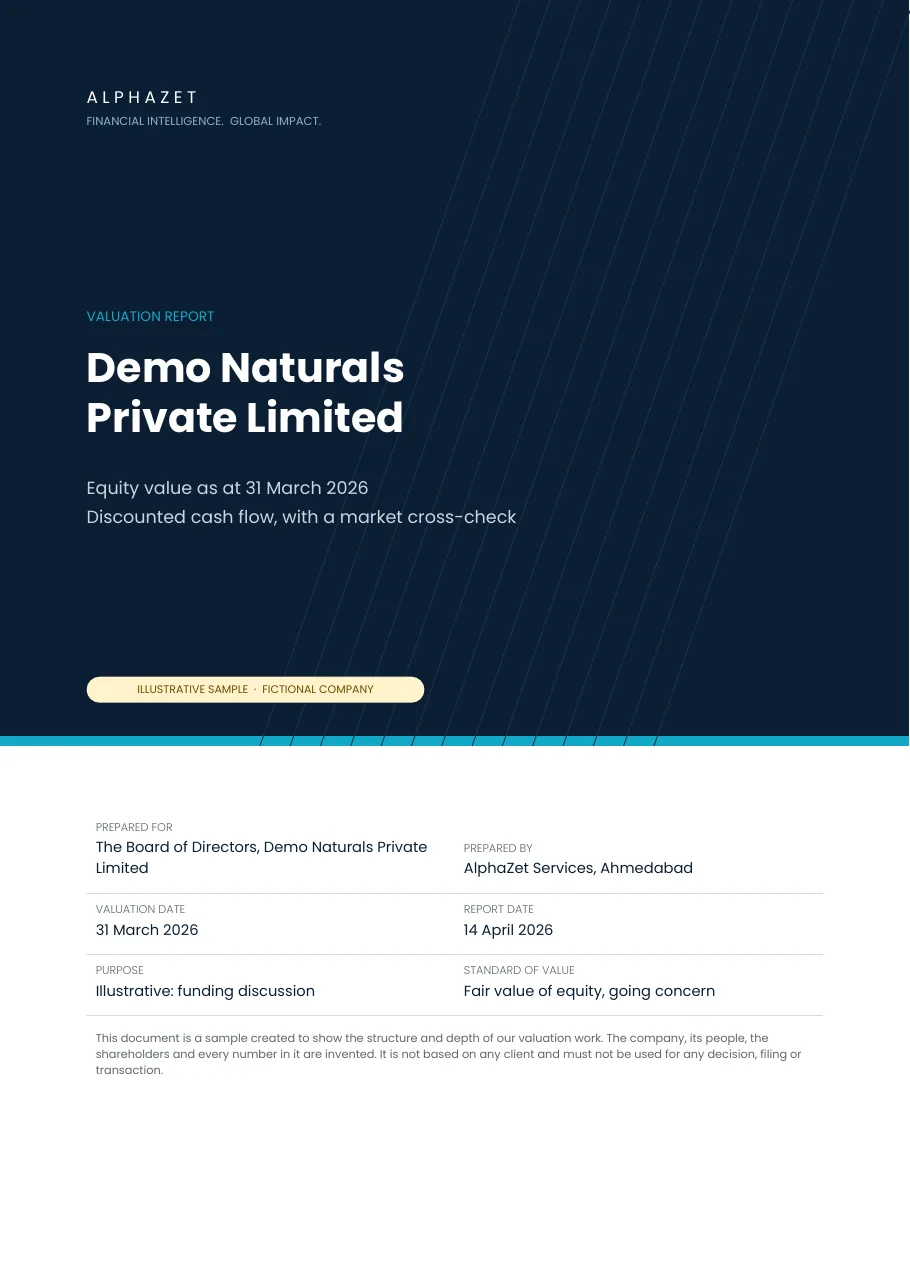 See a sample valuation report
Fictional company, no sign-up needed
Not sure this is the right service?
Tell us your situation and we will suggest the right route, free.
Our process
- 1
Discuss the purpose, valuation date and who will read the report
Same day - 2
Review your financial statements and projections
1 to 3 working days - 3
Choose the method and agree the written scope
Within 24 hours of review - 4
Build the valuation and test the assumptions
5 to 10 working days - 5
Walk you through the draft and take your comments
1 to 2 days - 6
Deliver final files, and arrange signing if required
After your sign-off
Documents we need
- 2 to 3 years of financial statements
- Current-year accounts to date
- Projections or business plan
- Shareholding and cap table
- Purpose of the valuation and the valuation date
Download checklist (PDF): Valuation document checklist
Name and phone are optional. Add them if you would like us to follow up.
Common mistakes to avoid
- Using a valuation prepared for one purpose (say fundraising) for a different purpose (such as share allotment)
- Forecasts built top-down from a market size with no link to your actual customers or capacity
- Ignoring existing ESOPs, convertible notes or SAFE-style instruments when computing ownership
- Picking comparables that are far larger or in a different business model
- Not recording the valuation date and the information the valuer relied on
Timeline and fees
Typical turnaround. Usually 1 to 3 weeks after we receive complete information.
What the fee depends on. the purpose and who will rely on the report; the valuation method and number of scenarios; number of projection years; how complete your records are; urgency.
Any fees charged by a valuer, bank or investor are separate.
Fees are confirmed in a written proposal before work starts.
For legal or regulatory use, a registered valuer's signature may be required.
Why AlphaZet
- We agree the scope, documents and timeline in writing before any work starts, so you know what you get and when.
- Work is led by a finance team with CFA-qualified members, and anything that needs a licensed signature (Chartered Accountant, Company Secretary, Registered Valuer or Advocate) is done through licensed partner professionals.
- Your documents and numbers are kept confidential, and we will sign an NDA if you ask.
- You get a plain-language explanation of every number or filing, so you can answer questions from a banker, investor or officer yourself.
- We tell you if a service is not right for your situation, and we do not guarantee approvals that depend on a government authority or bank.
Who does the work
Valuations for income-tax (Rule 11UA), FEMA or Companies Act purposes must be signed by a Registered Valuer or SEBI-registered Merchant Banker, as the law requires. We prepare the analysis and coordinate signing through our licensed partners.
Work that requires a licensed signature (Chartered Accountant, Company Secretary, Registered Valuer, Patent Agent, Advocate) is done through our network of licensed partner professionals. AlphaZet coordinates and remains your single point of contact.


Questions people ask
Who signs a valuation used for income-tax, FEMA or the Companies Act?
A Registered Valuer or SEBI-registered Merchant Banker, as the law requires. We prepare the analysis and coordinate signing through our licensed partners.
Which valuation method will you use?
It depends on your purpose and stage. Early-stage businesses are often valued on projected cash flows or comparable deals. Established businesses may use earnings, asset or cash-flow methods. We explain the choice in writing.
Can you tell me a number before I share documents?
No. A number without your financials is a guess, and we do not guess. Share your documents and we will give you a written scope and timeline first.
How long does a valuation take?
Usually one to three weeks after we receive complete information, depending on the purpose and complexity.
Do you value early-stage startups with no revenue?
Yes. We rely on projections, market evidence and comparable deals, and we are clear that the result is an estimate with stated assumptions.
Will my financial information stay confidential?
Yes. Your documents are used only for your assignment and shared only with the licensed professional who signs, where signing is required.
How is a startup valued in India?
Common methods are DCF, market multiples, the venture capital method and scorecard approaches for early stage. The right mix depends on revenue, stage and the purpose of the valuation.
Do I need a registered valuer for my startup?
It depends on the purpose. Several company law, FEMA and tax situations need a Registered Valuer or merchant banker. A valuation for internal planning or negotiation may not.